



By Dan Zarlenga, Missouri Department of Conservation
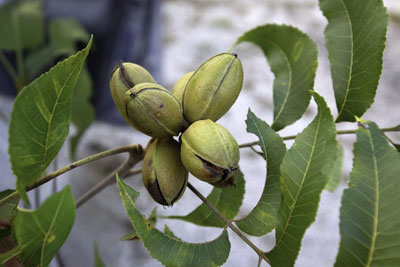
Photo caption: Ripe pecans! Photo courtesy the Missouri Department of Conservation.
With a forceful plunge, a small vessel disappears beneath swift-flowing water. It bobs to the surface, sinks again, and races downstream, leaving its point of origin miles behind. The raw power of a flood carries it on an uncharted voyage toward a new destination. Like a message in a bottle, this vessel also holds a hidden message. It is the blueprint for creating a new tree . . .
A favorite activity for the month of November is collecting nuts from the pecan tree. The green outer husks have already dried and split open and a huge crop of pecan nuts rains to the ground, ready for collecting. Wildlife and people flock to the flood plains and riverbanks where pecan trees often grow to collect the delicious and nutrient-packed nuts. November is pecan harvest time in Missouri.
Pecans are large trees with narrow, pyramid-shaped crowns if found in forests, or broad, rounded crowns growing in the open. They are actually in the same genus as hickory trees, and in fact are the largest of these.
Back to those nuts. There’s a good reason that pecans are so sought after by people. That rich, buttery, slightly sweet flavor! It makes them popular for use in baking, candy coating, or just eating plain. In fact, Missouri’s pecans are some of the most flavorful. Southern states may boast larger prize winners, but the Show-Me-State’s shorter and cooler growing season produces smaller pecans with a richer, more distinctive flavor. Because they have less growing time, the trees concentrate higher ratios of oils into a smaller kernel volume rather than storing water and bulk. This yields a noticeably richer, sweeter flavor. It’s truly a story of quality over quantity.
But there’s more than just a pretty flavor here. Gram for gram, native pecans are among the most energy-dense, high fat foods on the forest floor. A native pecan kernel is roughly 70% fat by weight—far outpacing white or red oak acorns in calorie density. This makes for the ultimate winter survival fuel, making them especially attractive to foraging wildlife.
As mentioned, pecan trees thrive in bottom land soils, and they use that in a unique reproductive strategy. The pecan nuts are actually buoyant. During a flooding event, ripe pecans that drop from the tree fall to the waters surrounding it. They become river-faring vessels that can convey themselves downstream for miles. Voyagers in a flood plain.
Within each nut is nature’s genetic message in a bottle, the sum of characteristics from its parent trees locked into one molecular-level recipe. As the waters recede, the pecan lands its recipe onto a freshly deposited mud bar. It may become the very first pioneer to help establish a new grove of pecan trees.
Nutritional powerhouse, unique genetic messenger, marvel of adaptation to a flood-prone land. A pecan nut is all of this. Yet, what’s most important to us during each November harvest is that singularly delightful Missouri pecan flavor. And that’s ok. There’s plenty enough value in that.